合作论文
“_”:本人,“#”:共同第一作者,“*”:通讯作者。
影响因子(IF)、分区信息以发表当年数据为准,期刊等级依据“福大人〔2021〕59 号”文件认定。
按时间倒序排列,由 jekyll-scholar 生成。
2025
-
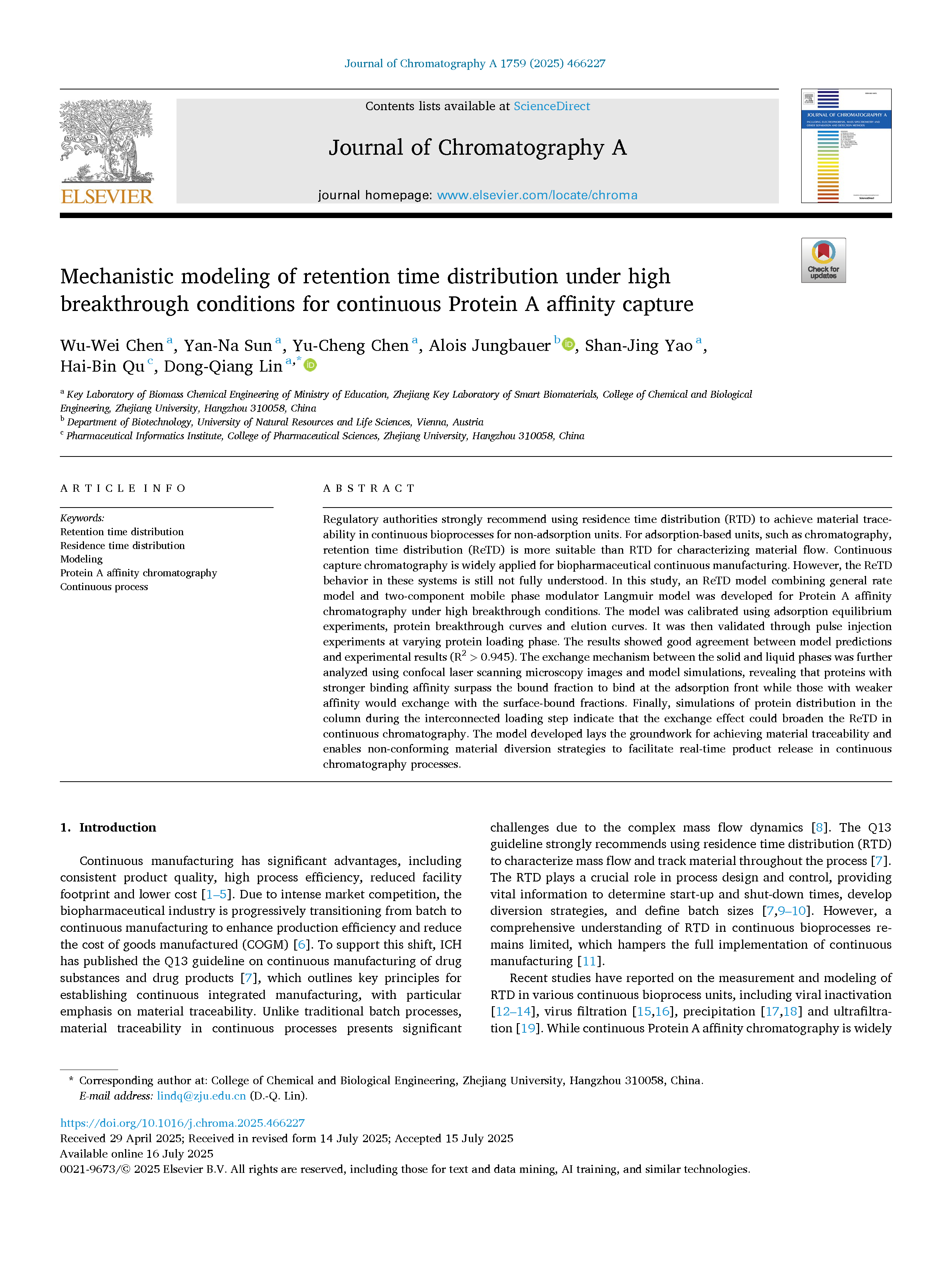 [6] Mechanistic modeling of retention time distribution under high breakthrough conditions for continuous Protein A affinity captureWu-Wei Chen, Yan-Na Sun, Yu-Cheng Chen, Alois Jungbauer, Shan-Jing Yao, Hai-Bin Qu, 和 Dong-Qiang Lin*Journal of Chromatography A, 2025, 1759: 466227
Regulatory authorities strongly recommend using residence time distribution (RTD) to achieve material traceability in continuous bioprocesses for non-adsorption units. For adsorption-based units, such as chromatography, retention time distribution (ReTD) is more suitable than RTD for characterizing material flow. Continuous capture chromatography is widely applied for biopharmaceutical continuous manufacturing. However, the ReTD behavior in these systems is still not fully understood. In this study, an ReTD model combining general rate model and two-component mobile phase modulator Langmuir model was developed for Protein A affinity chromatography under high breakthrough conditions. The model was calibrated using adsorption equilibrium experiments, protein breakthrough curves and elution curves. It was then validated through pulse injection experiments at varying protein loading phase. The results showed good agreement between model predictions and experimental results (R2 > 0.945). The exchange mechanism between the solid and liquid phases was further analyzed using confocal laser scanning microscopy images and model simulations, revealing that proteins with stronger binding affinity surpass the bound fraction to bind at the adsorption front while those with weaker affinity would exchange with the surface-bound fractions. Finally, simulations of protein distribution in the column during the interconnected loading step indicate that the exchange effect could broaden the ReTD in continuous chromatography. The model developed lays the groundwork for achieving material traceability and enables non-conforming material diversion strategies to facilitate real-time product release in continuous chromatography processes.
Retention time distribution; Residence time distribution; Modeling; Protein A affinity chromatography; Continuous process
@article{6,
  date = {2025/09/27},
  author = {Chen, Wu-Wei and Sun, Yan-Na and Chen, Yu-Cheng and Jungbauer, Alois and Yao, Shan-Jing and Qu, Hai-Bin and Lin, Dong-Qiang},
  title = {Mechanistic modeling of retention time distribution under high breakthrough conditions for continuous Protein A affinity capture},
  journal = {Journal of Chromatography A},
  volume = {1759},
  pages = {466227},
  keywords = {Retention time distribution;
  Residence time distribution;
  Modeling;
  Protein A affinity chromatography;
  Continuous process},
  doi = {10.1016/j.chroma.2025.466227},
  year = {2025},
}

2024
-
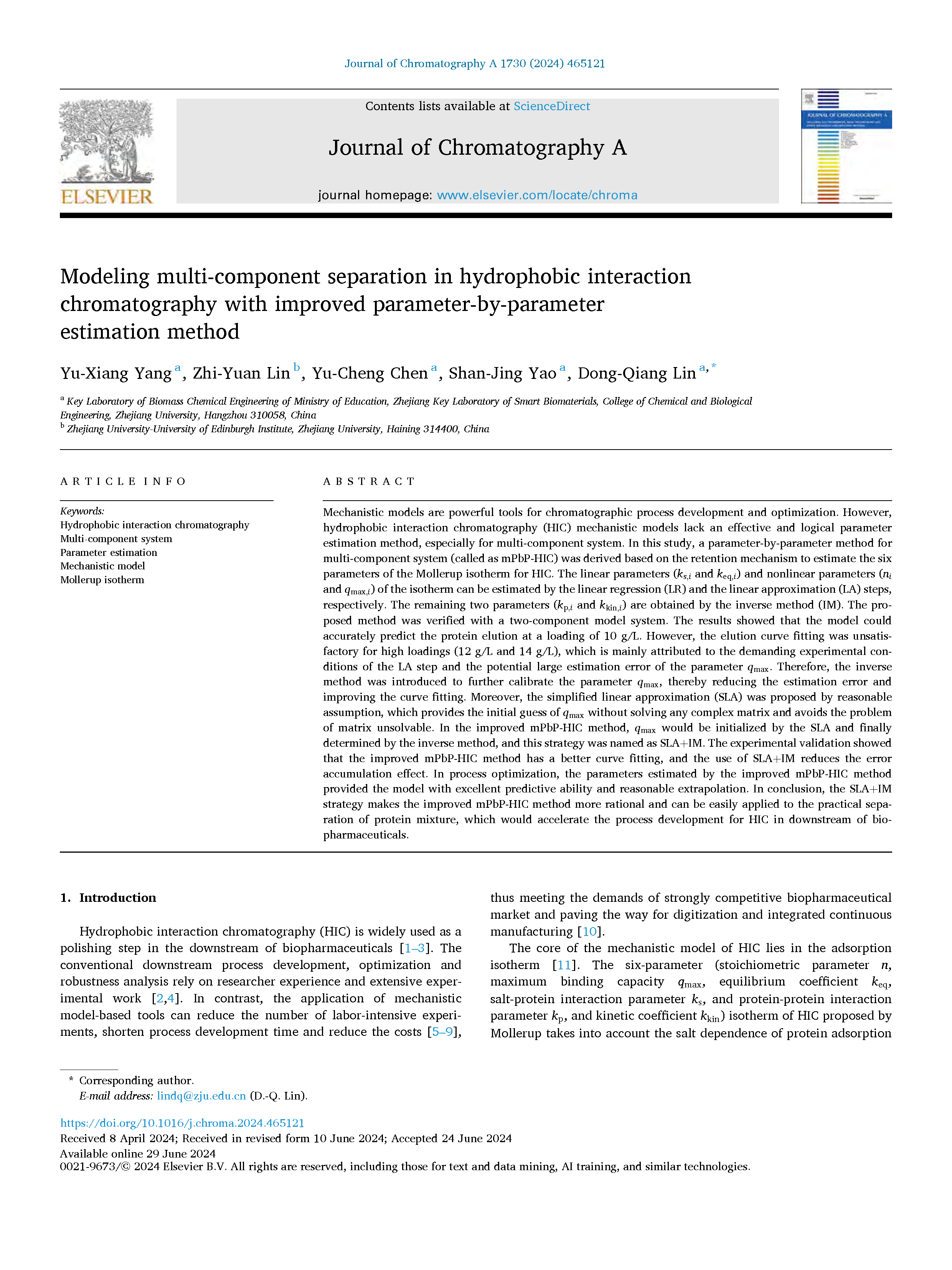 [5] Modeling multi-component separation in hydrophobic interaction chromatography with improved parameter-by-parameter estimation methodYu-Xiang Yang, Zhi-Yuan Lin, Yu-Cheng Chen, Shan-Jing Yao, 和 Dong-Qiang Lin*Journal of Chromatography A, 2024, 1730: 465121
Mechanistic models are powerful tools for chromatographic process development and optimization. However, hydrophobic interaction chromatography (HIC) mechanistic models lack an effective and logical parameter estimation method, especially for multi-component system. In this study, a parameter-by-parameter method for multi-component system (called as mPbP-HIC) was derived based on the retention mechanism to estimate the six parameters of the Mollerup isotherm for HIC. The linear parameters (ks,i and keq,i) and nonlinear parameters (ni and qmax,i) of the isotherm can be estimated by the linear regression (LR) and the linear approximation (LA) steps, respectively. The remaining two parameters (kp,i and kkin,i) are obtained by the inverse method (IM). The proposed method was verified with a two-component model system. The results showed that the model could accurately predict the protein elution at a loading of 10 g/L. However, the elution curve fitting was unsatisfactory for high loadings (12 g/L and 14 g/L), which is mainly attributed to the demanding experimental conditions of the LA step and the potential large estimation error of the parameter qmax. Therefore, the inverse method was introduced to further calibrate the parameter qmax, thereby reducing the estimation error and improving the curve fitting. Moreover, the simplified linear approximation (SLA) was proposed by reasonable assumption, which provides the initial guess of qmax without solving any complex matrix and avoids the problem of matrix unsolvable. In the improved mPbP-HIC method, qmax would be initialized by the SLA and finally determined by the inverse method, and this strategy was named as SLA+IM. The experimental validation showed that the improved mPbP-HIC method has a better curve fitting, and the use of SLA+IM reduces the error accumulation effect. In process optimization, the parameters estimated by the improved mPbP-HIC method provided the model with excellent predictive ability and reasonable extrapolation. In conclusion, the SLA+IM strategy makes the improved mPbP-HIC method more rational and can be easily applied to the practical separation of protein mixture, which would accelerate the process development for HIC in downstream of biopharmaceuticals.
Hydrophobic interaction chromatography; Multi-component system; Parameter estimation; Mechanistic model; Mollerup isotherm
@article{5, date = {2024/08/16}, author = {Yang, Yu-Xiang and Lin, Zhi-Yuan and Chen, Yu-Cheng and Yao, Shan-Jing and Lin, Dong-Qiang}, title = {Modeling multi-component separation in hydrophobic interaction chromatography with improved parameter-by-parameter estimation method}, journal = {Journal of Chromatography A}, volume = {1730}, pages = {465121}, keywords = {Hydrophobic interaction chromatography; Multi-component system; Parameter estimation; Mechanistic model; Mollerup isotherm}, doi = {10.1016/j.chroma.2024.465121}, year = {2024}, } -
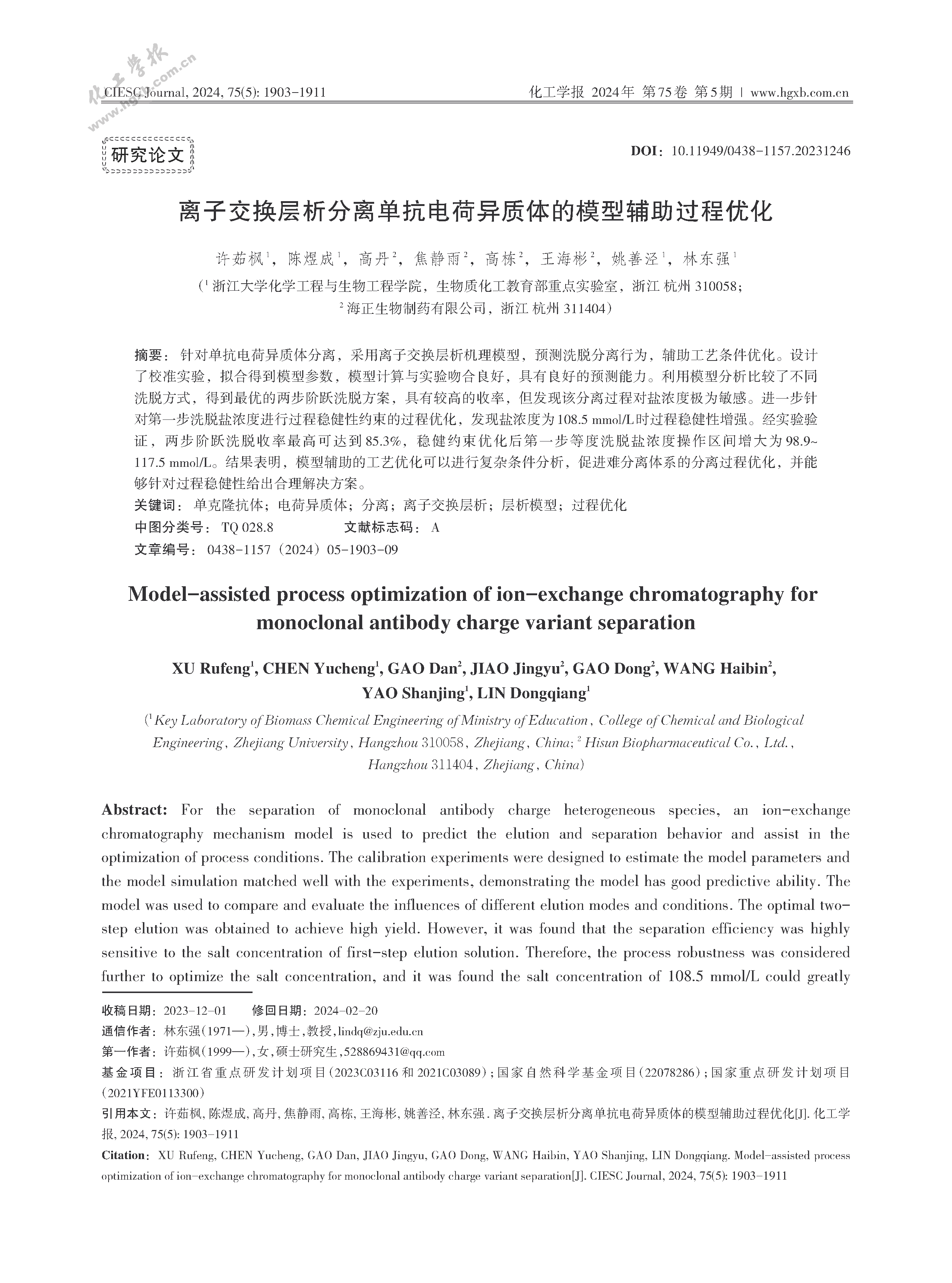 [4] 离子交换层析分离单抗电荷异质体的模型辅助过程优化化工学报, 2024, 75(5): 1-10
针对单抗电荷异质体分离,采用离子交换层析机理模型,预测洗脱分离行为,辅助工艺条件优化。设计了校准实验,拟合得到模型参数,模型计算与实验吻合良好,具有良好的预测能力。利用模型分析比较了不同洗脱方式,得到最优的两步阶跃洗脱方案,具有较高的收率,但发现该分离过程对盐浓度极为敏感。进一步针对第一步洗脱盐浓度进行过程稳健性约束的过程优化,发现盐浓度为105.8 mM时过程稳健性增强。经实验验证,两步阶跃洗脱收率最高可达到85.3%,稳健约束优化后第一步等度洗脱盐浓度操作区间增大为98.9 117.5 mM。结果表明,模型辅助的工艺优化可以进行复杂条件分析,促进难分离体系的分离过程优化,并能够针对过程稳健性给出合理解决方案。
单克隆抗体; 电荷异质体; 分离; 离子交换层析; 层析模型; 过程优化
@article{4, date = {2024/05/25}, author = {许茹枫 and 陈煜成 and 高丹 and 焦静雨 and 高栋 and 王海彬 and 姚善泾 and 林东强}, title = {离子交换层析分离单抗电荷异质体的模型辅助过程优化}, journal = {化工学报}, volume = {75}, number = {5}, pages = {1-10}, keywords = {单克隆抗体; 电荷异质体; 分离; 离子交换层析; 层析模型; 过程优化}, doi = {10.11949/0438-1157.20231246}, year = {2024}, } -
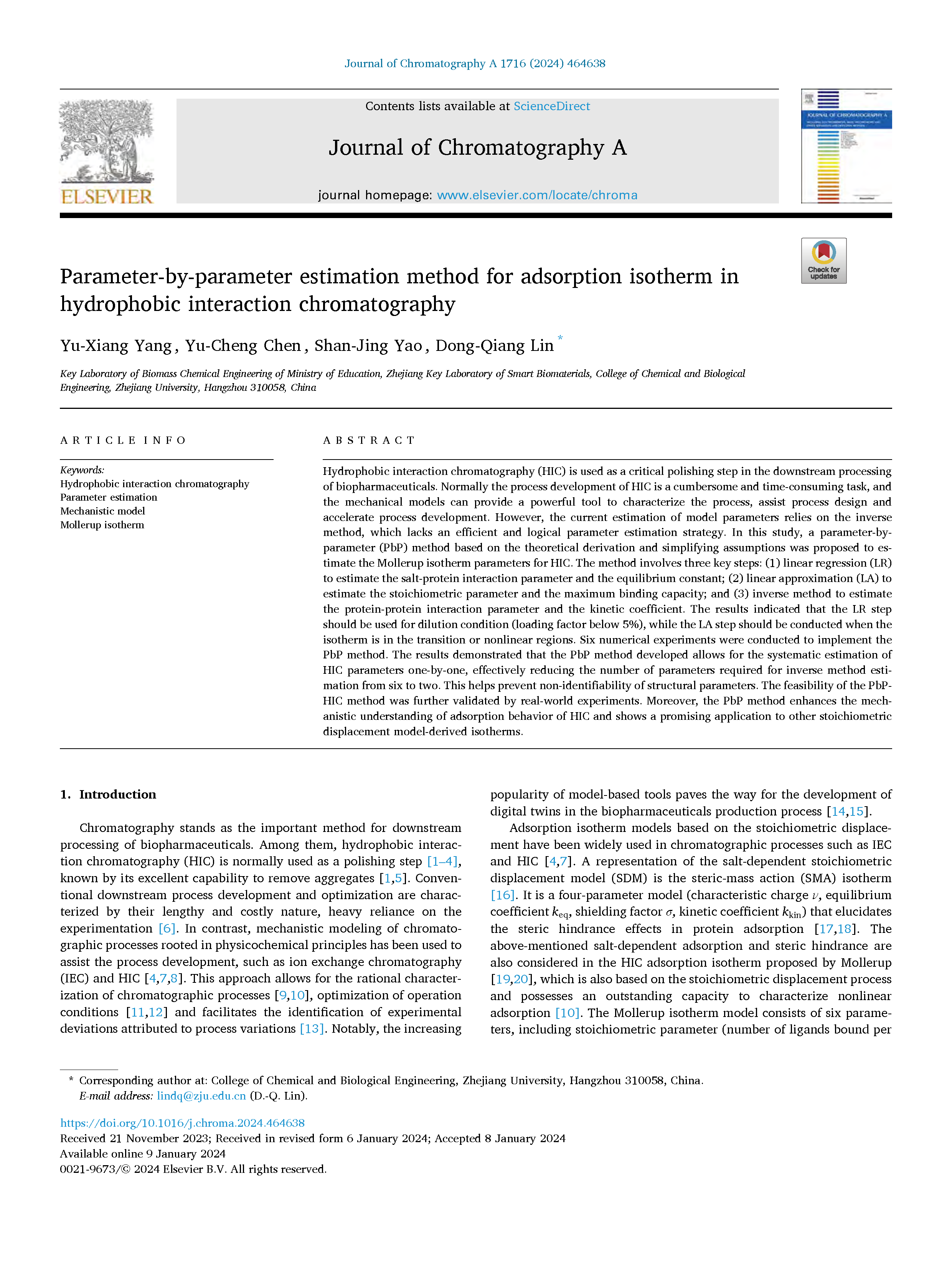 [3] Parameter-by-parameter estimation method for adsorption isotherm in hydrophobic interaction chromatographyYu-Xiang Yang, Yu-Cheng Chen, Shan-Jing Yao, 和 Dong-Qiang Lin*Journal of Chromatography A, 2024, 1716: 464638
Hydrophobic interaction chromatography (HIC) is used as a critical polishing step in the downstream processing of biopharmaceuticals. Normally the process development of HIC is a cumbersome and time-consuming task, and the mechanical models can provide a powerful tool to characterize the process, assist process design and accelerate process development. However, the current estimation of model parameters relies on the inverse method, which lacks an efficient and logical parameter estimation strategy. In this study, a parameter-by-parameter (PbP) method based on the theoretical derivation and simplifying assumptions was proposed to estimate the Mollerup isotherm parameters for HIC. The method involves three key steps: (1) linear regression (LR) to estimate the salt-protein interaction parameter and the equilibrium constant; (2) linear approximation (LA) to estimate the stoichiometric parameter and the maximum binding capacity; and (3) inverse method to estimate the protein-protein interaction parameter and the kinetic coefficient. The results indicated that the LR step should be used for dilution condition (loading factor below 5%), while the LA step should be conducted when the isotherm is in the transition or nonlinear regions. Six numerical experiments were conducted to implement the PbP method. The results demonstrated that the PbP method developed allows for the systematic estimation of HIC parameters one-by-one, effectively reducing the number of parameters required for inverse method estimation from six to two. This helps prevent non-identifiability of structural parameters. The feasibility of the PbP-HIC method was further validated by real-world experiments. Moreover, the PbP method enhances the mechanistic understanding of adsorption behavior of HIC and shows a promising application to other stoichiometric displacement model-derived isotherms.
Hydrophobic interaction chromatography; Parameter estimation; Mechanistic model; Mollerup isotherm
@article{3,
  date = {2024/02/08},
  author = {Yang, Yu-Xiang and Chen, Yu-Cheng and Yao, Shan-Jing and Lin, Dong-Qiang},
  title = {Parameter-by-parameter estimation method for adsorption isotherm in hydrophobic interaction chromatography},
  journal = {Journal of Chromatography A},
  volume = {1716},
  pages = {464638},
  keywords = {Hydrophobic interaction chromatography;
  Parameter estimation;
  Mechanistic model;
  Mollerup isotherm},
  doi = {10.1016/j.chroma.2024.464638},
  year = {2024},
}


2023
-
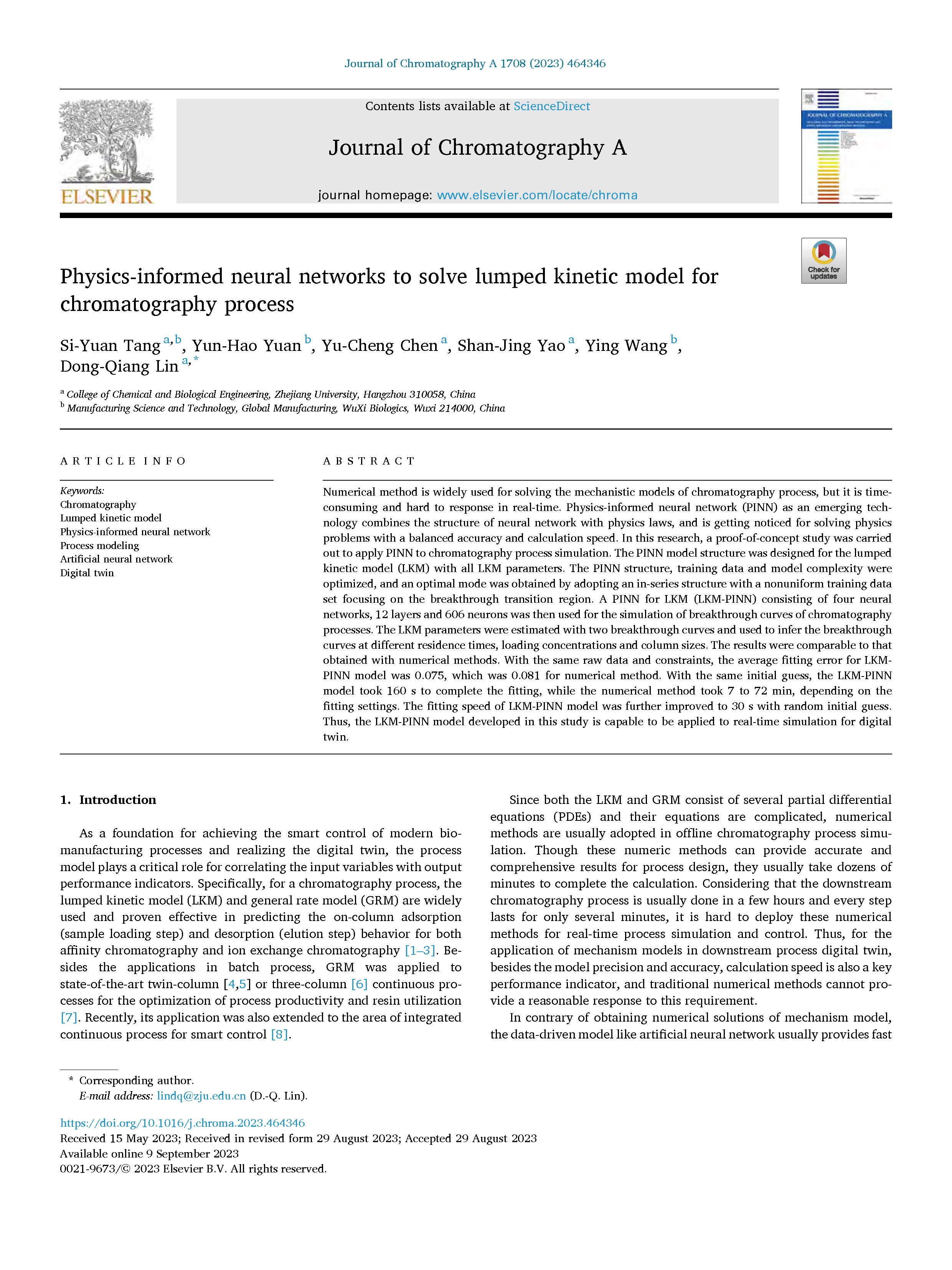 [2] Physics-informed neural networks to solve lumped kinetic model for chromatography processSi-Yuan Tang, Yun-Hao Yuan, Yu-Cheng Chen, Shan-Jing Yao, Ying Wang, 和 Dong-Qiang Lin*Journal of Chromatography A, 2023, 1708: 464346
Numerical method is widely used for solving the mechanistic models of chromatography process, but it is time-consuming and hard to response in real-time. Physics-informed neural network (PINN) as an emerging technology combines the structure of neural network with physics laws, and is getting noticed for solving physics problems with a balanced accuracy and calculation speed. In this research, a proof-of-concept study was carried out to apply PINN to chromatography process simulation. The PINN model structure was designed for the lumped kinetic model (LKM) with all LKM parameters. The PINN structure, training data and model complexity were optimized, and an optimal mode was obtained by adopting an in-series structure with a nonuniform training data set focusing on the breakthrough transition region. A PINN for LKM (LKM-PINN) consisting of four neural networks, 12 layers and 606 neurons was then used for the simulation of breakthrough curves of chromatography processes. The LKM parameters were trained with two breakthrough curves and used to infer the breakthrough curves at different residence times, loading concentrations and column sizes. The results were comparable to that obtained with numerical methods. With the same raw data and constraints, the average fitting error for LKM-PINN model was 0.075, which was 0.081 for numerical method. With the same initial guess, the LKM-PINN model took 160 s to complete the fitting, while the numerical method took 7 to 72 min, depending on the fitting settings. The fitting speed of LKM-PINN model was further improved to 30 s with random initial guess. Thus, the LKM-PINN model developed in this study is capable to be applied to real-time simulation and realize some of the functions of digital twin.
Chromatography; Lumped kinetic model; Physics-informed neural network; Process modeling; Artificial neural network; Digital twin
@article{2,
  date = {2023/10/11},
  author = {Tang, Si-Yuan and Yuan, Yun-Hao and Chen, Yu-Cheng and Yao, Shan-Jing and Wang, Ying and Lin, Dong-Qiang},
  title = {Physics-informed neural networks to solve lumped kinetic model for chromatography process},
  journal = {Journal of Chromatography A},
  volume = {1708},
  pages = {464346},
  keywords = {Chromatography;
  Lumped kinetic model;
  Physics-informed neural network;
  Process modeling;
  Artificial neural network;
  Digital twin},
  doi = {10.1016/j.chroma.2023.464346},
  year = {2023},
}

2021
-
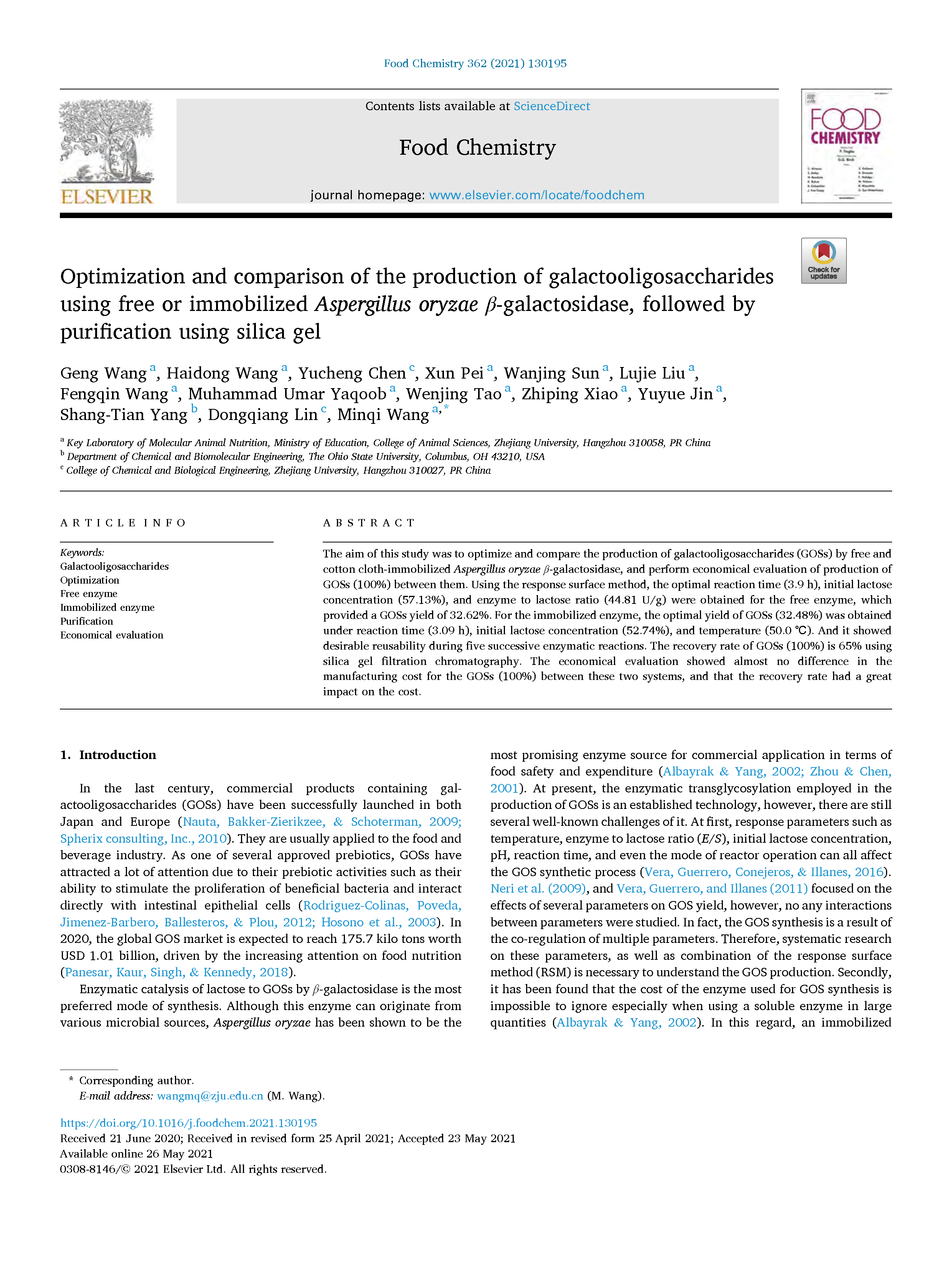 [1] Optimization and comparison of the production of galactooligosaccharides using free or immobilized Aspergillus oryzae beta-galactosidase, followed by purification using silica gelGeng Wang, Haidong Wang, Yucheng Chen, Xun Pei, Wanjing Sun, Lujie Liu, Fengqin Wang, Muhammad Umar Yaqoob, Wenjing Tao, Zhiping Xiao, Yuyue Jin, Shang-Tian Yang, Dongqiang Lin, 和 Minqi Wang*Food Chemistry, 2021, 362: 130195
The aim of this study was to optimize and compare the production of galactooligosaccharides (GOSs) by free and cotton cloth-immobilized Aspergillus oryzae beta-galactosidase, and perform economical evaluation of production of GOSs (100%) between them. Using the response surface method, the optimal reaction time (3.9 h), initial lactose concentration (57.13%), and enzyme to lactose ratio (44.81 U/g) were obtained for the free enzyme, which provided a GOSs yield of 32.62%. For the immobilized enzyme, the optimal yield of GOSs (32.48%) was obtained under reaction time (3.09 h), initial lactose concentration (52.74%), and temperature (50.0 ). And it showed desirable reusability during five successive enzymatic reactions. The recovery rate of GOSs (100%) is 65% using silica gel filtration chromatography. The economical evaluation showed almost no difference in the manufacturing cost for the GOSs (100%) between these two systems, and that the recovery rate had a great impact on the cost.
Galactooligosaccharides; Optimization; Free enzyme; Immobilized enzyme; Purification; Economical evaluation
@article{1,
  date = {2021/11/15},
  author = {Wang, Geng and Wang, Haidong and Chen, Yucheng and Pei, Xun and Sun, Wanjing and Liu, Lujie and Wang, Fengqin and Yaqoob, Muhammad Umar and Tao, Wenjing and Xiao, Zhiping and Jin, Yuyue and Yang, Shang-Tian and Lin, Dongqiang and Wang, Minqi},
  title = {Optimization and comparison of the production of galactooligosaccharides using free or immobilized Aspergillus oryzae beta-galactosidase, followed by purification using silica gel},
  journal = {Food Chemistry},
  volume = {362},
  pages = {130195},
  keywords = {Galactooligosaccharides;
  Optimization;
  Free enzyme;
  Immobilized enzyme;
  Purification;
  Economical evaluation},
  doi = {10.1016/j.foodchem.2021.130195},
  year = {2021},
}
